Troubleshooting
Ratchet Strap Won't Tighten
Rethread a single flat layer through the mandrel, pull the slack out by hand, then crank. If the pawl still will not hold, replace the ratchet.
By StrapRank ·
When a ratchet strap will not tighten, the webbing is usually threaded so the mandrel cannot wind it, or the pawl is not falling into a tooth. The handle can wave all afternoon and the cargo will not get snug. Pull the slack out by hand first. A ratchet is a winder, not a winch for a pile of loose ribbon. If a straight, single layer still will not take up, the mechanism is done and the strap should be replaced.
The use guide shows a normal thread. This page is for the strap that looks threaded and still will not get tight. The likely causes:
- The tail went through the slot backward, so cranking feeds webbing out instead of on
- The tail is too short and pops back out of the slot on the first swing
- The release tab is held open, so the pawl never sits in a tooth
- The spool is already full, and more cranking only polishes the handle
- Oil, a twist, or a doubled layer is letting the webbing slip inside the slot
- The gear teeth are worn smooth, so the pawl clicks without catching
Watch one crank with the cargo still loose. If the roll gets fatter, the thread is right and something else is slipping: a hook, a soft surface, or a strap that is simply too long for the bite you have left. If the roll does not change, you are not winding. Fix the thread before you blame the cargo.
See whether it is the thread or the pawl
Unhook the strap so you are not diagnosing it on a load. Open the handle flat, empty the mandrel, and lay the webbing out without a twist. The fixed short end, the one sewn to the ratchet, stays put. The long end is what you feed.
Feed that long end through the slot in the mandrel and pull a generous tail through, enough that two or three cranks cannot spit it back out. The common direction on a consumer ratchet is up through the slot so the tail lies over the roll as you crank. If your model is marked with an arrow, follow the marking on the frame. A strap that gets looser as you crank is threaded the other way. Pull it out and reverse it. Do not keep cranking "to see if it catches."
Let go of the release tab. The pawl is the little tooth that drops into the gear. If you pinch the tab while you crank, you are holding the pawl up and the mandrel freewheels. That feels like a broken ratchet and it is just a thumb in the wrong place. Crank with the tab released. You should hear a click at the end of each stroke, and the roll should stay put when you let go of the handle.
A full spool will not tighten further. If the handle is already hard to close because the roll is fat, you have used the length. Back webbing off, move the hooks closer to the cargo, or use a shorter strap. Crushing more webbing into a full mandrel chews the edges and still does not add tension.
Try the empty test. Three clicks, then stop. Pull on the long end. It should not slip back through the slot. If it slurps back out, the tail was too short, the layer was doubled, or the slot is worn so wide that one thickness cannot bite. A worn slot is retirement. You cannot shim it and keep the rating.
Also check the hooks while you are there. A strap that "will not tighten" is sometimes a hook sliding up a rail or out of a hole. The webbing is fine. The end fitting is walking. Seat the hook, then tension. Coated hooks protect paint. The coating does not add working load.
Make it take up slack
- Remove the strap from the load and open the handle fully so the mandrel is free.
- Pull all the wound webbing off. Leave a single flat ribbon, no twist, from hook to hook.
- Feed the long end through the mandrel slot in the direction the frame shows, or up through the slot if there is no mark. Pull a real tail through.
- Release the inner tab. Crank slowly. Each stroke should add webbing to the roll and end in a click that holds.
- If the roll shrinks instead of growing, reverse the feed. If there is no click, watch the pawl. It has to drop. Clean grit out of the teeth and try again.
- Put the hooks on the anchors, pull the remaining slack out by hand, then crank until the cargo is secure and the handle still closes flat and locks.
- Tie or band the free tail so it cannot whip. Do not knot the loaded section. A knot is not tension, and it reduces the strength of the webbing.
- Recheck after the first miles, or after the trailer has bounced. Settling is not a failed ratchet.
If the pawl rides on top of rounded teeth, or the spring that pushes it down is gone, cleaning will not fix it. Replace the assembly. Do not weld, peen, or file a "sharper" tooth. That is a new, unmarked part wearing an old tag.
For everyday tightening trouble that ends in a worn mechanism, the replacement StrapRank points to is the AUGO 1 in × 15 ft 4-pack. The listing publishes a 733 lb load capacity and a 2,200 lb break strength, coated S-hooks with safety locks, soft loops, and a bag. Read the sewn tag. The review keeps the published numbers in one place. If you need a higher published capacity in a short pair, AUGO's 1.5 in × 10 ft straps list 1,466 lb and a 4,400 lb break strength. They are still not a substitute for a marked 2-inch assembly when the job calls for one.
AUGO 1 in × 15 ft ratchet strap 4-pack
StrapRank's editor's pick for a general-purpose consumer kit. The listing publishes a 2,200 lb break strength and a 733 lb load capacity on 1-inch by 15-foot straps, and the kit includes coated S-hooks, soft loops, bungees, and a bag.
- Width
- 1 in
- Length
- 15 ft
- Quantity
- 4 straps
- Published working load
- 733 lb load capacity
- Published break strength
- 2,200 lb
- Fittings
- Rubber-coated S-hooks with safety locks
No StrapRank lab test. Confirm the sewn tag on the strap you receive.
Check price on Amazon$33.99In StockPrice as of November 27, 2026, 12:46 PM ET. Prices and availability are accurate as of the date/time indicated and are subject to change. Any price and availability information displayed on Amazon.com at the time of purchase will apply to the purchase of this product.
Green 4-pack listing$33.99In StockPrice as of November 27, 2026, 12:46 PM ET. Prices and availability are accurate as of the date/time indicated and are subject to change. Any price and availability information displayed on Amazon.com at the time of purchase will apply to the purchase of this product.
Orange 4-pack listing
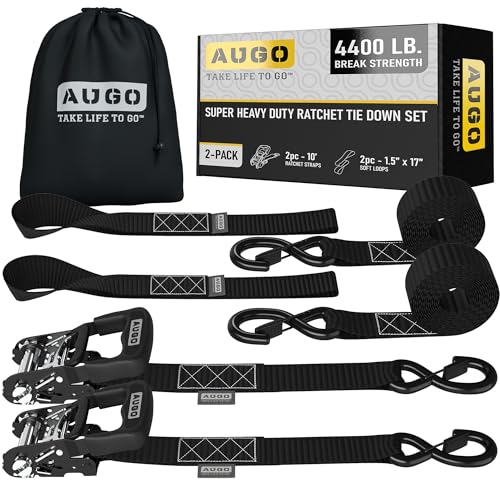
AUGO 1.5 in × 10 ft ratchet strap 2-pack
A two-strap AUGO kit with a published 4,400 lb break strength and 1,466 lb load capacity. Wider and shorter than the 15-foot editor's pick.
- Width
- 1.5 in
- Length
- 10 ft
- Quantity
- 2 straps
- Published working load
- 1,466 lb load capacity
- Published break strength
- 4,400 lb
- Fittings
- Rubber-coated S-hooks with safety latches
Break strength and load capacity are the manufacturer's published figures, not a StrapRank test.
Check price on AmazonStay inside the working load on the tag of whatever you install. The anchor, the hook, and the webbing share one rating: the lowest one. On a commercial vehicle, 49 CFR Part 393 is the rule set, including how much aggregate working load the tie-downs need. A blog sentence does not certify a load. Follow the strap maker's threading picture if it disagrees with a generic description.
Keep the next crank honest
A strap that will not tighten is often a strap that was put away wrong. Coil it with the mandrel empty enough to accept a new feed, handle closed, webbing dry. Salt left in the teeth becomes the grit that holds the pawl up next Saturday.
Before you crank on a real load:
- Flat webbing, one layer, a tail you can still see after the first clicks
- Hooks seated, not balanced on a round edge
- Release tab free, not pinched
- Handle able to close and lock when you stop
- A second strap so one miss is not the whole plan
Replace the strap when the slot is bell-mouthed, the teeth are polished smooth, the webbing is cut or glazed from slipping, or the tag is gone. Fuzzy surface fibers from ordinary use are not the same thing as a cut. A cut that severs yarns is retirement. Cut the scrap webbing so it cannot go back on a trailer "for a light load." Light loads still deserve a known working load.
Questions readers actually ask
Why does my ratchet click but the strap stays loose?
The pawl may be clicking on the return without the mandrel winding, or the hooks are slipping. Watch the roll. If it does not get thicker, rethread. If the roll grows and the cargo does not snug up, reseat the hooks.
Can I tie a knot to make a short tail catch?
No. Knots in the loaded webbing reduce strength, and a knot in the slot is how straps jam. Pull a longer tail through, or use a strap that fits.
Should I keep cranking if the handle will barely close?
No. That is a full spool or an overloaded strap. Stop, close the handle if you can do it by hand, and move to a better length or a higher marked working load.
Keep reading
The strap these steps use
As an Amazon Associate I earn from qualifying purchases. Full disclosure. Specs on this page are the published listing figures, not a StrapRank lab test. The tag sewn on the strap wins, and a commercial load still has to follow the cargo-securement rules that apply to the trip. Recheck the AUGO listing before you buy.