Troubleshooting
How to Thread a Ratchet Strap
Open the handle flat, feed one untwisted layer through the mandrel slot, leave a tail, and crank only after the slack is out by hand.
By StrapRank ·
Threading a ratchet strap is the whole job. If the long end misses the mandrel slot, or goes through it backward, nothing you do with the handle will tension the cargo. Open the handle until it lies flat, feed a single untwisted layer through the slot, pull a tail through, and only then start to crank. Most "broken" ratchets on a driveway are a missed slot.
The use guide walks a normal tie-down from anchor to anchor. This page stays on the thread itself: which end moves, which way it enters, and the mistakes that make the strap look installed when it is only draped.
People get stuck on the same few errors:
- The long webbing is laid over the ratchet instead of through the slot
- The tail is so short that the first crank spits it out
- A twist just outside the slot becomes a lump inside it
- The fixed end, the short piece sewn to the ratchet, is the one they try to feed
- The handle is only half open, so the slot is covered and the webbing cannot enter
- Leftover webbing from last time is still on the mandrel, and the new feed stacks on a mess
If the strap gets longer as you crank, the feed is reversed. If the handle moves and the webbing does not, you missed the slot. Both are threading problems. Neither one is fixed by a longer cheater bar.
Set the ratchet up so the slot is open
Find the two ends before you touch the cargo. One hook is on a short piece of webbing that is fixed to the ratchet frame. Leave that end alone. The other hook is on the long webbing. That long piece is what you thread. If both ends look long, the one that slides freely through your hand, with no stitching at the ratchet, is the tail.
Open the handle all the way flat, past the normal cranking arc, while holding the inner release if the pawl blocks the slot. You need to see a clear opening in the center roller, the mandrel. If old webbing is already wound there, pull it off until the slot is a slot again, not a buried seam in a roll. Threading on top of a leftover roll is how straps jam and how handles stop closing.
Hold the webbing flat. A quarter twist outside the ratchet becomes a full jam inside it. Run your hand from the hook to the ratchet and let the webbing unroll. Face the same side up the whole way. Then feed.
On most consumer ratchets the tail enters the slot from below and comes out the top, so it lies over the growing roll as you crank. Some frames are stamped with an arrow. The arrow wins. Pull through enough tail that you could wrap it around your hand and still have webbing in the slot. There is no universal inch-count that fits every mandrel. "Enough that three cranks cannot drop the tail out" is the practical test. Tug the tail. It should stay.
The AUGO 1 in × 15 ft kit is the everyday strap StrapRank uses when the example has to be a real product. The listing publishes a 733 lb load capacity and a 2,200 lb break strength, four straps, coated S-hooks with safety locks, and soft loops. The soft loops do not go through the mandrel. They go around an anchor, and the hook goes through the loop. Stuffing a loop into the slot is a jam, not a shortcut. The AUGO review has the rest of the published kit.
Feed it, then tension it
- Hook or loop the fixed end to the anchor that will not move while you work.
- Run the long webbing over or around the cargo with no twist. Keep it off sharp edges, exhaust, and moving parts.
- Open the handle flat and pass the long end through the mandrel slot. Follow the arrow if there is one.
- Pull the tail through until the strap is snug by hand and a tail still sticks out of the slot.
- Let go of the release. Crank the handle through its short arc. You should hear a click and see the roll grow.
- Stop when the cargo is secure and the handle can still close flat and lock down. Do not keep clicking because the package quoted a large break strength.
- Close and latch the handle. A handle left up is a hook for brush, a door, or your leg.
- Band or tuck the free tail. Do not knot it into the loaded span. The storage notes show what to do with the leftover length later.
If the first cranks dump the tail back out, you did not pull enough through, or the webbing was doubled and too thick to bite. Empty the slot and feed one layer. If the cargo is painted, a boat, or a cabinet, stop early. A ratchet's mechanical advantage will crush things a cam buckle would only hold. That choice is in the buying guide, under cam buckle versus ratchet.
Check the working load on the tag before you call the thread finished. A perfect feed on a 1-inch consumer strap does not make it a flatbed strap. The lowest rated part in the system, including the anchor, is the limit. Commercial cargo securement lives in 49 CFR Part 393. Follow that and the manufacturer when the load is in commerce. A threaded strap with a missing tag is not "probably fine." It is an unmarked assembly. Retire it.
When threading fails because the slot is crushed or the webbing is too chewed to feed flat, replace the strap rather than fighting the hardware. The AUGO 15-foot 4-pack is the everyday replacement. If the real complaint is a tail you are always winding up, AUGO's retractable 2 in × 10 ft pair is the kit built to pull leftover webbing back in. The listing publishes a 1,000 lb load capacity and a 3,000 lb break strength. Retractable hardware can change the assembly rating, so the tag on that strap, not the webbing width, is the number you use.
AUGO 1 in × 15 ft ratchet strap 4-pack
StrapRank's editor's pick for a general-purpose consumer kit. The listing publishes a 2,200 lb break strength and a 733 lb load capacity on 1-inch by 15-foot straps, and the kit includes coated S-hooks, soft loops, bungees, and a bag.
- Width
- 1 in
- Length
- 15 ft
- Quantity
- 4 straps
- Published working load
- 733 lb load capacity
- Published break strength
- 2,200 lb
- Fittings
- Rubber-coated S-hooks with safety locks
No StrapRank lab test. Confirm the sewn tag on the strap you receive.
Check price on Amazon$33.99In StockPrice as of November 27, 2026, 12:46 PM ET. Prices and availability are accurate as of the date/time indicated and are subject to change. Any price and availability information displayed on Amazon.com at the time of purchase will apply to the purchase of this product.
Green 4-pack listing$33.99In StockPrice as of November 27, 2026, 12:46 PM ET. Prices and availability are accurate as of the date/time indicated and are subject to change. Any price and availability information displayed on Amazon.com at the time of purchase will apply to the purchase of this product.
Orange 4-pack listing
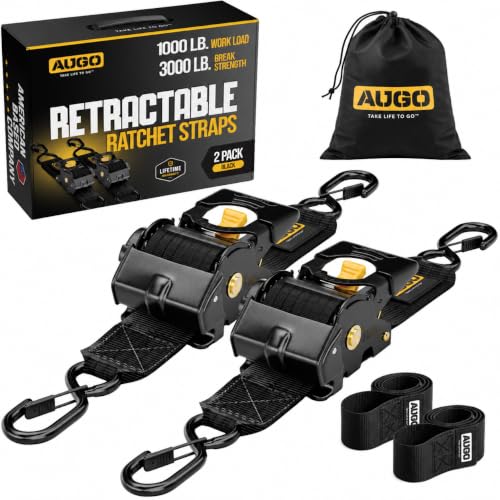
AUGO retractable 2 in × 10 ft ratchet strap 2-pack
AUGO's retractable pair. The listing publishes a 3,000 lb break strength and a 1,000 lb load capacity on 2-inch by 10-foot straps, with a mechanism meant to retract extra webbing.
- Width
- 2 in
- Length
- 10 ft
- Quantity
- 2 straps
- Published working load
- 1,000 lb working load limit
- Published break strength
- 3,000 lb
- Fittings
- S-hooks with safety locks
Retractable hardware can change the assembly rating. Use the tag on the strap, not the webbing width alone.
$59.49In StockPrice as of November 27, 2026, 12:46 PM ET. Prices and availability are accurate as of the date/time indicated and are subject to change. Any price and availability information displayed on Amazon.com at the time of purchase will apply to the purchase of this product.
Check price on AmazonMake the next thread boring
Threading gets hard when the strap is stored as a ball. Wind the long end loosely, handle closed, slot empty enough to see. Dry it. A wet, twisted coil is the next jam.
On the load, give yourself a routine you do not have to invent each time:
- Fixed end on the anchor, long end over the cargo, slot last
- One flat layer, a visible tail, then clicks
- Handle closed and locked before the vehicle moves
- A look at the tag if you cannot remember the working load
- Replacement, not a field stitch, when the slot or the webbing is damaged
Cut a retired strap so the slot cannot be "borrowed." Two straps, each inside its marked working load, are the minimum habit. One perfectly threaded strap is still a single point of failure.
Questions readers actually ask
Which end do I push through the slot?
The long free end. The short end sewn to the ratchet frame stays put. If you try to feed the fixed end, there is nothing to pull through.
The webbing goes in and immediately slips back out. What now?
Pull a longer single layer through before you crank, and make sure it is not doubled. A worn, widened slot that cannot bite one layer means the ratchet is finished.
Do I thread a soft loop through the ratchet?
No. Put the loop around the anchor and put the strap's hook through the loop. The mandrel slot only wants the strap webbing.
Keep reading
The strap these steps use
As an Amazon Associate I earn from qualifying purchases. Full disclosure. Specs on this page are the published listing figures, not a StrapRank lab test. The tag sewn on the strap wins, and a commercial load still has to follow the cargo-securement rules that apply to the trip. Recheck the AUGO listing before you buy.