Troubleshooting
Ratchet Strap Too Long
Wind the spare tail and band it. Do not cut the webbing to shorten a rated strap. Use a shorter or retractable strap if the extra length is the whole problem.
By StrapRank ·
A ratchet strap that is too long is a tail-management problem, not a reason to cut the webbing. The length on the package is the long end, and you will not use all of it on a small load. The spare has to be wound, banded, or retracted so it cannot whip the paint, catch a wheel, or drag on the road. Cutting the load-bearing webbing and sewing it, or melting the end and hoping, destroys the assembly the tag described. You do not get a shorter strap with the same working load. You get scrap.
Too long shows up as a specific annoyance:
- A coil of leftover webbing after the cargo is already tight
- The tail cracking against the truck or the load on the highway
- A mandrel so full of unused webbing that the handle will not close
- Someone tying knots in the spare and accidentally knotting the loaded span
- A 27-foot strap used across a pickup bed, where most of it is just wind
Fifteen feet, the length on StrapRank's everyday AUGO pick, is enough for a lot of truck beds and still leaves a tail. That tail is normal. A strap that is too short is the trip you should not start. A strap that is too long is a trip you can make if you control the extra.
Decide whether you have spare tail or the wrong strap
Tension the load correctly first. Hooks on real anchors, one flat layer in the slot, handle able to lock. The use guide is that sequence. Whatever webbing is still loose after the handle locks is the tail. It is not holding the cargo. It is just attached to the part that is.
If the mandrel is packed and the handle will not close, you wound the spare onto the ratchet instead of leaving it as a free tail. Back it off. The mandrel only needs enough webbing to hold the tension. The rest stays outside, where you can band it. A full spool that keeps you from locking the handle is less safe than a tidy tail, not more.
If the "extra" is actually in the loaded span, looped around the cargo three times because the strap was enormous, look at that honestly. Extra wraps can help keep a loose item from sliding, but a knot, a bunch, or a twist in the span that is carrying the load is not free strength. Makers tell you not to knot load-bearing webbing. Route it simply. Control the leftover at the end.
Measure the job with your eye, not with a new break-strength claim. A pickup bed rarely needs a 27-foot freight strap. A roof box rarely needs one either. Using a huge strap "because it is stronger" confuses length with rating. The working load is on the tag. Length is just length. The buying guide separates those ideas. If you are always banding six feet of tail, a shorter strap or a retractable one is the more comfortable tool. It is not required for safety as long as the tail is controlled and the tag matches the load.
Watch the tail on a test roll in the driveway. If it can reach a tire, a driveshaft, a hot exhaust, or the road, it is not controlled. That is the failure mode of "too long," and it is solved before you leave.
Control the extra without wrecking the rating
- Tension and lock the handle with only the webbing you need on the mandrel.
- Pull the free tail so it is a single flat ribbon, not a twist and not a knot.
- Fold or roll that tail against the strap or a safe part of the cargo. Keep it off paint if the end hardware can knock.
- Band it. A dedicated strap band, a soft tie, or the bungee that came in a kit for tail control is doing a housekeeping job, not a working-load job. Do not count a bungee as a tie-down.
- Make sure the band cannot slide to the wheel or the pavement. Tuck the end.
- If the tail is so long that banding it is a project every single time, stop using that length for this job.
- Choose a shorter assembly, or a retractable one, whose tag still covers the load. Do not shorten the old one with a knife.
- Recheck the band when you recheck tension. A band that left the tail is the same hazard as before.
AUGO's 15-foot 4-pack is the length StrapRank points everyday users toward, with a published 733 lb load capacity and a 2,200 lb break strength, plus two bungees in the kit that are useful for controlling leftover line. They are not cargo straps. The coated S-hooks have safety locks, and the bag gives the extra webbing a home when you are done. Read the tag. The review has the published details.
If the leftover webbing is the reason you avoid using the straps, AUGO's retractable 2 in × 10 ft pair is built so the extra pulls back into the housing. The listing publishes a 1,000 lb load capacity and a 3,000 lb break strength. Use the tag on that assembly. Retractable hardware is not "a 2-inch strap" in the commercial sense just because the webbing is wide. The storage guide still applies when you put either kit away.
AUGO 1 in × 15 ft ratchet strap 4-pack
StrapRank's editor's pick for a general-purpose consumer kit. The listing publishes a 2,200 lb break strength and a 733 lb load capacity on 1-inch by 15-foot straps, and the kit includes coated S-hooks, soft loops, bungees, and a bag.
- Width
- 1 in
- Length
- 15 ft
- Quantity
- 4 straps
- Published working load
- 733 lb load capacity
- Published break strength
- 2,200 lb
- Fittings
- Rubber-coated S-hooks with safety locks
No StrapRank lab test. Confirm the sewn tag on the strap you receive.
Check price on Amazon$33.99In StockPrice as of November 27, 2026, 9:44 AM ET. Prices and availability are accurate as of the date/time indicated and are subject to change. Any price and availability information displayed on Amazon.com at the time of purchase will apply to the purchase of this product.
Green 4-pack listing$33.99In StockPrice as of November 27, 2026, 9:44 AM ET. Prices and availability are accurate as of the date/time indicated and are subject to change. Any price and availability information displayed on Amazon.com at the time of purchase will apply to the purchase of this product.
Orange 4-pack listing
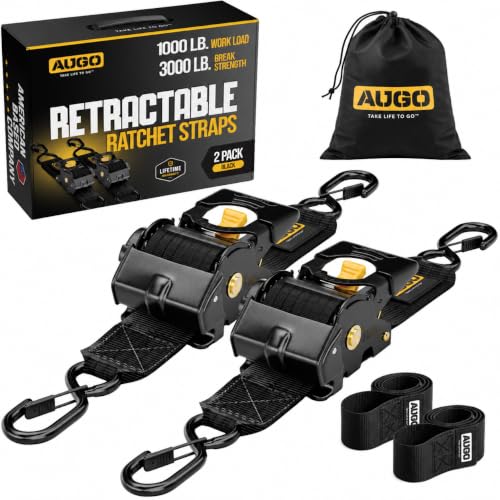
AUGO retractable 2 in × 10 ft ratchet strap 2-pack
AUGO's retractable pair. The listing publishes a 3,000 lb break strength and a 1,000 lb load capacity on 2-inch by 10-foot straps, with a mechanism meant to retract extra webbing.
- Width
- 2 in
- Length
- 10 ft
- Quantity
- 2 straps
- Published working load
- 1,000 lb working load limit
- Published break strength
- 3,000 lb
- Fittings
- S-hooks with safety locks
Retractable hardware can change the assembly rating. Use the tag on the strap, not the webbing width alone.
$59.49In StockPrice as of November 27, 2026, 9:44 AM ET. Prices and availability are accurate as of the date/time indicated and are subject to change. Any price and availability information displayed on Amazon.com at the time of purchase will apply to the purchase of this product.
Check price on AmazonA 10-foot retractable pair can be too short for a tall load. Too long and too short are both real. Pick the length that leaves a manageable tail and still reaches anchors that are part of the vehicle. On a commercial trip, 49 CFR Part 393 and the manufacturer govern the tie-down. A neatly banded tail does not change the working load math.
Make length a choice, not a surprise
Keep two lengths if you do two jobs. A 15-foot everyday kit and a longer, higher-marked strap for the rare long reach is a clearer bin than one giant strap used for everything.
Habits that keep the tail boring:
- Wind only what the mandrel needs, band the rest
- No knots in the loaded span
- No tails near tires, exhaust, or the road
- No cutting to customize a tagged assembly
- Replace webbing that is cut, melted, or missing its tag, and cut that scrap so it stays scrap
The working load on the strap you did not cut is the number you already had. Protect it by leaving the webbing whole. Two straps, both the right length for the anchors, both inside their tags, are the setup. A shortened mystery strap is not a clever third option.
Questions readers actually ask
Can I cut the tail off if I never use it?
No. The free tail is part of the same webbing the assembly was rated as. Cutting it to length is how you lose that rating. Band the tail, or buy a shorter strap.
Is a retractable strap the same working load as a regular 2-inch strap?
No. Read its tag. AUGO's retractable listing publishes 1,000 lb load capacity and 3,000 lb break strength. Other 2-inch straps in this catalog publish different numbers. Width is not the rating.
What if the long strap is the only one that reaches?
Use it, control the tail, and stay inside its marked working load. Length does not make a small working load larger, and it does not make a large one safe on a weak anchor.
Keep reading
The strap these steps use
Related fixes
As an Amazon Associate I earn from qualifying purchases. Full disclosure. Specs on this page are the published listing figures, not a StrapRank lab test. The tag sewn on the strap wins, and a commercial load still has to follow the cargo-securement rules that apply to the trip. Recheck the AUGO listing before you buy.