Troubleshooting
Ratchet Strap Won't Catch
Clean the gear teeth, let the pawl drop, and replace the ratchet if the teeth are rounded or the spring is gone.
By StrapRank ·
A ratchet strap that will not catch tightens for a moment and then gives the webbing back, or it never clicks at all. The pawl, the small tooth that drops into the gear, is not staying in a tooth. Sometimes your thumb is holding the release up. Sometimes the teeth are packed with grit or worn smooth. A strap that will not catch is not a strap you tension and drive on. Either the pawl starts holding, or you replace the assembly.
This is narrower than "it will not get tight." A strap can fail to get tight because it is threaded backward and the roll never grows. Here the handle may click, or it may feel empty, and the tension will not stay when you let go. Watch the roll. If it grows and then slips back a tooth when you release the handle, the catch is the fault.
The catch fails in a few familiar ways:
- The release tab is pinched, so the pawl cannot drop
- Grease, salt, or a pebble sits in the tooth the pawl needs
- The teeth are rounded, and the pawl rides up and off
- The pawl spring is weak, broken, or gone
- The frame is sprung, so the pawl no longer lines up with the gear
- The webbing is so slippery with oil that it creeps even when the gear holds
The use guide shows a healthy click. This page is the click that lies.
Watch the pawl, not just the handle
Empty the strap off the load. You want the gear where you can see it. Open the handle and look at the pawl while you move the release tab. The pawl should rise when you pull the tab and snap down when you let go. If it stays up, something is holding it: your grip, a bent tab, or debris. Free it. If it stays down and will not lift, it may be jammed. Do not grind it free with a drill. Clean it. If the metal is peened over or rusted solid, that mechanism is finished.
Crank slowly through one stroke and stop. The pawl should fall into a tooth and hold the mandrel when you ease your hand off the handle. If the handle kicks back and the roll unwinds, the pawl never sat. Try a different tooth. If every tooth kicks back, the pawl tip or the teeth are rounded. You can see it. Sharp teeth look like saw teeth. Worn ones look like waves. Waves will not hold a load that vibrates. Replace the ratchet. Do not file "sharper" teeth. A filed gear is an unmarked part wearing an old tag.
Grit is the case that still might be a clean-up. Pick the teeth clean. Rinse salt. Dry the metal. A dry pawl that now snaps and holds can go back to work if the webbing and the tag are intact. Oil is optional and easy to overdo. A drop on a sticky pivot is enough. A gear bathed in grease holds the next handful of sand, and the catch fails again. Keep oil off the webbing. Oily webbing slips in the slot even when the gear is honest, and it collects the grit you just removed.
A sprung frame shows up as a pawl that hits the side of a tooth instead of the face. The side plates look bowed. That is overload damage, often from a pipe on the handle. Retire it. You cannot squeeze the plates in a vise and recover the working load printed on the tag.
Make it hold, or scrap it
- Remove the strap from the cargo. Hold the load with something else if it still needs restraint.
- Watch the pawl while you work the release. It must drop on its own.
- Clean the teeth. Dry them. Take grease out rather than adding more.
- Crank one stroke and release the handle. The mandrel should stay. Tug the webbing. It should not slip back through the slot.
- If it holds empty, thread it properly, one flat layer, and tension the cargo inside the marked working load. Lock the handle.
- Tug again with the cargo secured. A slip now means you are not done. Do not leave.
- If teeth are rounded, the spring is missing, or the frame is bent, replace the whole assembly. Do not swap in a screw as a pawl.
- Cut retired webbing so a freewheeling ratchet cannot be the emergency spare.
The everyday replacement StrapRank names is the AUGO 1 in × 15 ft 4-pack. The listing publishes a 733 lb load capacity and a 2,200 lb break strength, coated S-hooks with safety locks, and soft loops. A new catch does not raise the strength of your anchors. Read the tag on arrival. The AUGO review is the spec page. If you are replacing the strap because the old one's working load was too low for the cargo, look at AUGO's 1.5 in × 10 ft pair, which publishes 1,466 lb and a 4,400 lb break strength, and then decide whether the job is actually a marked 2-inch strap. The buying guide keeps that choice honest.
AUGO 1 in × 15 ft ratchet strap 4-pack
StrapRank's editor's pick for a general-purpose consumer kit. The listing publishes a 2,200 lb break strength and a 733 lb load capacity on 1-inch by 15-foot straps, and the kit includes coated S-hooks, soft loops, bungees, and a bag.
- Width
- 1 in
- Length
- 15 ft
- Quantity
- 4 straps
- Published working load
- 733 lb load capacity
- Published break strength
- 2,200 lb
- Fittings
- Rubber-coated S-hooks with safety locks
No StrapRank lab test. Confirm the sewn tag on the strap you receive.
Check price on Amazon$33.99In StockPrice as of November 27, 2026, 9:44 AM ET. Prices and availability are accurate as of the date/time indicated and are subject to change. Any price and availability information displayed on Amazon.com at the time of purchase will apply to the purchase of this product.
Green 4-pack listing$33.99In StockPrice as of November 27, 2026, 9:44 AM ET. Prices and availability are accurate as of the date/time indicated and are subject to change. Any price and availability information displayed on Amazon.com at the time of purchase will apply to the purchase of this product.
Orange 4-pack listing
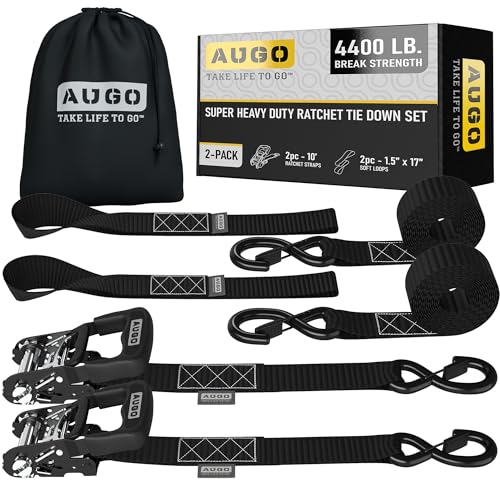
AUGO 1.5 in × 10 ft ratchet strap 2-pack
A two-strap AUGO kit with a published 4,400 lb break strength and 1,466 lb load capacity. Wider and shorter than the 15-foot editor's pick.
- Width
- 1.5 in
- Length
- 10 ft
- Quantity
- 2 straps
- Published working load
- 1,466 lb load capacity
- Published break strength
- 4,400 lb
- Fittings
- Rubber-coated S-hooks with safety latches
Break strength and load capacity are the manufacturer's published figures, not a StrapRank test.
Check price on AmazonStay at or under the working load. Break strength is the failure number, not the catch's promise. On a commercial vehicle, 49 CFR Part 393 expects tie-downs that hold, with working loads you can read. A pawl that slips is an out-of-service strap. Follow the regulation and the maker, not a filed tooth.
Give the next pawl a clean gear
Catches fail early when the strap lives in a wet bin.
- Store it dry, handle latched, teeth not packed with mud. The storage guide is the habit
- Test the click before the first real crank of the day
- No pipes on the handle, which is how teeth and frames die
- No grease baths
- Replace at the first slip you cannot clean away
- Keep the tag. A catching ratchet with no working load marked is still an unknown
Two straps that hold, each inside its tag, are the system. One strap you have to crank and hold with your hand is not caught. Scrap it.
Questions readers actually ask
It clicks, but I can still pull the webbing out. Is that a catch problem?
Yes, or the webbing is not really in the slot. If the roll does not turn while you pull webbing out, the tail is slipping in the slot. If the roll unwinds, the pawl is not holding. Clean it or replace it.
Can I add a second pawl or a pin to make it catch?
No. Extra hardware is not the rated mechanism. Replace the assembly.
Why did it start slipping after I oiled it?
Oil plus grit fills the teeth, and oil on the webbing lets the slot slip. Clean it dry. A tiny amount on a rusty pivot is the limit, and none of it belongs on the webbing.
Keep reading
The strap these steps use
As an Amazon Associate I earn from qualifying purchases. Full disclosure. Specs on this page are the published listing figures, not a StrapRank lab test. The tag sewn on the strap wins, and a commercial load still has to follow the cargo-securement rules that apply to the trip. Recheck the AUGO listing before you buy.