Troubleshooting
Ratchet Strap Keeps Loosening
Close and lock the handle, seat the hooks, and add a second strap. If the pawl will not hold a click, replace the mechanism.
By StrapRank ·
A ratchet strap that keeps loosening is usually a handle that never locked, a hook that walked off its anchor, or cargo that settled after the first miles. The webbing did not magically stretch like a rubber band. Find which of those three is moving before you crank the same strap tighter and call it fixed. Over-cranking a strap that is already at its working load is how webbing and anchors fail.
Start with the handle. After the last click, the handle should lie flat and latch. A handle left at an angle lets the mandrel creep backward under bounce. Then look at the hooks. An S-hook without a latch can hop out of a hole the moment the strap goes slack for a second. Then look at the load. A cooler, a stack of lumber, or a bike suspension will settle. The strap was tight on a tall stack and loose on a short one. That is physics, and the fix is a recheck, not a bigger break-strength number on the package.
The usual list:
- Handle not closed flat, or the latch not engaged
- Only a tooth or two holding, because the crank stopped between clicks
- Hook backed off a rail, a stake pocket, or a round bar
- Cargo compressed, shifted, or bounced
- Webbing running over a slippery cover or a loose tarp
- Pawl or teeth worn so the click does not actually hold
- One strap doing a job that needs two, so any slip is the whole system
The truck bed guide is the setup page for pickups. This page is the "it was tight when I left and loose at the ramp" page.
Separate settling from a failed click
Put the vehicle in park, or stop the trailer, before you test anything. Tug the webbing in the middle. If it barely moves and the cargo is still planted, you may be feeling normal give in the load, not a failed strap. If you can pull a new length through the system, something released.
Watch the mandrel while a helper gently rocks the cargo, or while you push the load the way the road would. If the roll unwinds click by click, the pawl is not holding. Clean the teeth. If they are rounded or the pawl spring is weak, stop using that ratchet. A strap that dumps tension in your driveway will dump it on the highway.
If the roll does not unwind and the hooks have moved, the hardware walked. S-hooks need a hole or a ring they cannot climb out of. A hook balanced on the top of a round tube will leave. Coated hooks, including the safety-lock S-hooks on the AUGO everyday kit, are there to stay put and to save paint. The coating is not a working-load upgrade. Seat the hook fully. If the anchor is a rail, a double J-hook is often the shape that belongs there, which is why a long 2-inch strap with J-hooks shows up later in this article.
If neither the roll nor the hooks moved, the cargo got shorter. Strap it again at the new height. Add a strap so one point of settle is not the only restraint. Recheck after the first few miles and again if you leave pavement. That recheck is normal. It is not a sign that ratchet straps "always loosen."
Vibration plus a single strap is the other pattern. One strap over a tall load can hop. Two straps, crossed or spaced, give the cargo less room to start that hop. The working load of each strap still counts on its own. You do not add their break strengths and call the sum a rating. Use the working load on each tag. The buying guide shows how commercial rules aggregate those numbers under 49 CFR 393.106. A personal truck is still subject to the basic duty not to spill a load. A commercial vehicle has to meet the regulation.
Reset it so it stays tight
- Stop. If the load has shifted, fix that before you tension anything.
- Close the handle flat and confirm the latch holds it down. If the handle springs back up, clear webbing out from under it or replace a bent latch.
- Reseat every hook. The open part of the hook should not point in the direction the strap will yank if it goes slack.
- Pull fresh slack out by hand, then crank to a firm hold. Stop while the handle can still lock. The last violent clicks are not free strength.
- Add a second strap on anything that could shift, tip, or bounce. One strap is a single failure.
- Band the tails. A flapping tail is not tension, but it can open a hook or chew paint.
- Drive a short distance and check again. Adjust once. If you are adjusting every few minutes, the anchor or the strap class is wrong.
- If the pawl will not hold a stationary tug, retire that assembly. Do not "backup crank" it and hope.
Knots will not stop loosening. They make a hard spot that slips and they cut the strength of the webbing. A bungee over a ratchet strap is not a working-load device either. Use it only to control a tail, if you use it at all.
When the everyday kit is worn out or the hooks will not stay in ordinary anchors, replace it with a known assembly. StrapRank's editor's pick is the AUGO 1 in × 15 ft 4-pack: published 733 lb load capacity, 2,200 lb break strength, safety-lock S-hooks, and soft loops. Read the tag you receive. The AUGO review explains the pick. If the loosening is a 1-inch hook on a long rail that really wants a J-hook and a higher marked working load, look at KEEPER's 2 in × 27 ft tie-down. The listing publishes a 3,333 lb working load and a 10,000 lb break strength, with double J-hooks. That is a different class of tool. Confirm you are buying one strap, which is what the title describes.
AUGO 1 in × 15 ft ratchet strap 4-pack
StrapRank's editor's pick for a general-purpose consumer kit. The listing publishes a 2,200 lb break strength and a 733 lb load capacity on 1-inch by 15-foot straps, and the kit includes coated S-hooks, soft loops, bungees, and a bag.
- Width
- 1 in
- Length
- 15 ft
- Quantity
- 4 straps
- Published working load
- 733 lb load capacity
- Published break strength
- 2,200 lb
- Fittings
- Rubber-coated S-hooks with safety locks
No StrapRank lab test. Confirm the sewn tag on the strap you receive.
Check price on Amazon$33.99In StockPrice as of November 27, 2026, 12:46 PM ET. Prices and availability are accurate as of the date/time indicated and are subject to change. Any price and availability information displayed on Amazon.com at the time of purchase will apply to the purchase of this product.
Green 4-pack listing$33.99In StockPrice as of November 27, 2026, 12:46 PM ET. Prices and availability are accurate as of the date/time indicated and are subject to change. Any price and availability information displayed on Amazon.com at the time of purchase will apply to the purchase of this product.
Orange 4-pack listing
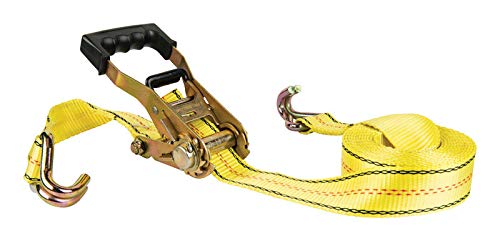
KEEPER 2 in × 27 ft ratchet tie-down with J-hooks
KEEPER's 2-inch by 27-foot ratchet tie-down. The listing publishes a 3,333 lb working load limit and a 10,000 lb break strength, with double J-hooks.
- Width
- 2 in
- Length
- 27 ft
- Quantity
- 1 tie-down
- Published working load
- 3,333 lb
- Published break strength
- 10,000 lb
- Fittings
- Double J-hooks
Confirm the cart is a single strap. The title does not describe a multi-pack.
Check price on AmazonMatch the tag to the job. A 3,333 lb mark does not belong on a kayak hull, and a 733 lb mark does not become a flatbed rating because you own four of them. The manufacturer’s instructions for the fitting, and 49 CFR Part 393 when it applies, outrank a habit that "usually holds."
Prevent the slack from coming back
Loosening is mostly a routing and a recheck problem.
- Hooks in real anchors, fully seated, latches closed if the hook has them
- Webbing flat, off sharp edges, not running on a loose tarp that can slide
- Handle closed and latched, not propped on the roll
- Two straps on a load that can shift
- A stop after the first miles, then again if the road changes
- Dry storage so the pawl is not glued with rust next time
Replace the strap when teeth are rounded, the latch will not hold the handle, hooks are opening up, webbing is cut or heat-glazed, or the tag is missing. Inspect for those before you blame the road. Cut retired webbing. A spare with no tag is how an unknown rating gets back on the truck.
Questions readers actually ask
Is it normal for straps to loosen on a long drive?
Cargo settles and suspensions move, so a recheck is normal. A mandrel that unwinds by itself, or a hook that leaves its anchor, is not normal. Fix that hardware.
Will a tighter crank stop the loosening?
Only if the strap was actually slack and still inside its working load. Cranking past a locked handle overloads the assembly and can be why it fails.
Do safety latches on the hooks replace a second strap?
No. A latch helps the hook stay put. You still want a second tie-down so one failure is not the whole load.
Keep reading
The strap these steps use
Related fixes
As an Amazon Associate I earn from qualifying purchases. Full disclosure. Specs on this page are the published listing figures, not a StrapRank lab test. The tag sewn on the strap wins, and a commercial load still has to follow the cargo-securement rules that apply to the trip. Recheck the AUGO listing before you buy.