Troubleshooting
Ratchet Strap Hook Won't Stay On
Seat the hook in a real anchor with the latch closed, or switch to a J-hook or a soft loop when the anchor shape is wrong.
By StrapRank ·
When a ratchet strap hook will not stay on, the hook and the anchor do not match, or the hook is only balanced on an edge. An S-hook wants a hole, a ring, or a slot it can sit down in. A round bar, a thin lip, or a painted tube lets it climb off the moment the strap bounces slack. Change the fitting or change the anchor. Cranking harder makes the hop more violent. It does not make the hook a latch.
This is the hook problem specifically. If the mandrel is unwinding, that is a pawl problem, not a hook problem. If the whole strap goes soft because the cargo settled, recheck tension after you know the hooks are actually captured.
Hooks leave for a short list of reasons:
- The S-hook is set on top of a rail instead of through a hole
- There is no safety latch, or the latch is bent open
- The hook is too wide for the hole and never seated
- The open end of the hook points the way the strap will tug
- The anchor is a tube that needs a soft loop, not a hook at all
- The hook has started to straighten, so the throat is wider than it was
The buying guide sorts S-hooks, J-hooks, flat hooks, and loops. Use that if you are choosing hardware. Use this page if the hook you already own keeps hitting the ground.
Match the hook to the thing it is grabbing
Look at the anchor before you look at the strap. A round hole in a stake pocket, a D-ring, or a trailer loop can hold an S-hook if the hook passes through and sits with the load pulling it into the hole, not out of it. The open part of the hook should be shielded by the way the webbing pulls. If a bump lifts the strap, a hook that opens upward can hop free. Turn it so the opening is not the escape route.
A safety latch, the wire or spring gate on many coated S-hooks, has to close behind the anchor. If the gate is crushed flat, it is decoration. Bend it back only if it still springs. A gate that stays open is a reason to replace the assembly, not a detail. AUGO's 15-foot kit lists rubber-coated S-hooks with safety locks. Those locks are useful on ordinary holes. They do not make an S-hook correct for a rub rail.
A rail, a side channel, or a stake pocket shaped for a flat grab is a J-hook or a flat-hook job. An S-hook on that rail sits on a corner and walks. Double J-hooks, the kind on long 2-inch tie-downs, are made to bear on that kind of edge. Forcing an S-hook because it is what you have is how hooks straighten. A hook that has opened up is damaged. The working load on the tag included the hook when it was the shape the maker tested. An opened hook is a different, weaker part.
Tubes and bars are the soft-loop case. A hook around a roof-rack bar or a bumper will chew paint and pop off. A soft loop chokes the bar, and the hook goes through the loop's ends. Do not put that loop on a brake line, a fuel line, a plastic trim piece, or a sharp flange. The motorcycle guide is the place for bike anchor points. Follow the bike maker's tiedown points. Do not invent one on a fork tube if the manual says not to.
Pull test before you leave. With the strap tensioned and the handle locked, push the hook toward its opening. If you can lift it out with a finger, the road can lift it out. Reseat it or change fittings. The webbing's break strength does not keep a loose hook on a rail.
Seat it so a bounce cannot lift it
- Pick the anchor that is part of the vehicle, not a thin bracket you hope will hold.
- Put the hook fully through the hole or onto the rail the fitting was shaped for. The latch, if there is one, closes after the hook is seated, not before.
- Point the hook opening away from the direction a slack strap would throw it.
- Take the slack out by hand, crank until the load is secure, and lock the handle. Tension should pull the hook deeper into the anchor, not out of it.
- Push the hook. If it lifts out, stop and change the setup. A soft loop around a closed section, with the hook in the loop, is the usual fix for a tube.
- Add a second strap. One hook's failure should not be the whole load.
- If the hook is bent open, cracked, or the latch is gone, retire the strap. Do not weld the throat closed. Welding near webbing damages fibers you cannot see, and a welded hook is not the rated fitting.
- Recheck the hooks, not just the middle of the strap, after the first miles.
For everyday anchors that suit an S-hook, the replacement StrapRank names is the AUGO 1 in × 15 ft 4-pack. Published load capacity 733 lb, break strength 2,200 lb, safety-lock S-hooks, soft loops included. The loops are the right answer when the hook itself is the wrong shape. Read the tag. The AUGO review spells out the kit. When the anchor is a long rail and the working load needs to be in the 3,333 lb class, KEEPER's 2 in × 27 ft tie-down publishes that working load, a 10,000 lb break strength, and double J-hooks. Compare the jobs on the AUGO versus KEEPER page before you treat them as substitutes.
AUGO 1 in × 15 ft ratchet strap 4-pack
StrapRank's editor's pick for a general-purpose consumer kit. The listing publishes a 2,200 lb break strength and a 733 lb load capacity on 1-inch by 15-foot straps, and the kit includes coated S-hooks, soft loops, bungees, and a bag.
- Width
- 1 in
- Length
- 15 ft
- Quantity
- 4 straps
- Published working load
- 733 lb load capacity
- Published break strength
- 2,200 lb
- Fittings
- Rubber-coated S-hooks with safety locks
No StrapRank lab test. Confirm the sewn tag on the strap you receive.
Check price on Amazon$33.99In StockPrice as of November 27, 2026, 12:46 PM ET. Prices and availability are accurate as of the date/time indicated and are subject to change. Any price and availability information displayed on Amazon.com at the time of purchase will apply to the purchase of this product.
Green 4-pack listing$33.99In StockPrice as of November 27, 2026, 12:46 PM ET. Prices and availability are accurate as of the date/time indicated and are subject to change. Any price and availability information displayed on Amazon.com at the time of purchase will apply to the purchase of this product.
Orange 4-pack listing
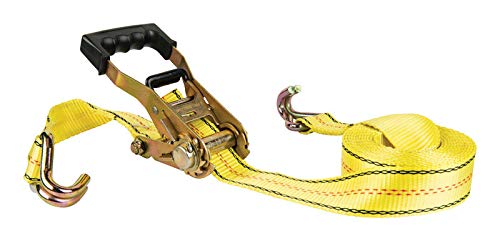
KEEPER 2 in × 27 ft ratchet tie-down with J-hooks
KEEPER's 2-inch by 27-foot ratchet tie-down. The listing publishes a 3,333 lb working load limit and a 10,000 lb break strength, with double J-hooks.
- Width
- 2 in
- Length
- 27 ft
- Quantity
- 1 tie-down
- Published working load
- 3,333 lb
- Published break strength
- 10,000 lb
- Fittings
- Double J-hooks
Confirm the cart is a single strap. The title does not describe a multi-pack.
Check price on AmazonStay inside the marked working load of the assembly you actually hooked up. The hook, the webbing, and the anchor share the lowest number. On a commercial vehicle, 49 CFR Part 393 still decides the tie-down, including using fittings the way they are designed. An S-hook on a bumper is a good way to damage a bumper. It is not a designed mounting point for hauling a car. That job wants axle straps, which the trailer guide covers.
Give the hook less chance to leave
A hook stays on when the geometry is boring.
- The fitting shape matches the anchor shape
- The latch closes, or you are using a loop because there is no latch that fits
- The pull of the strap draws the hook into the anchor
- You checked it with a push, not only with a glance
- Nothing sharp is the thing you hooked
- Damaged hooks get cut out of service with the webbing
Replace the strap when a hook is opening, cracked, missing its latch and the load depends on that latch, or the tag is unreadable. Do not mix a random hook onto old webbing and keep the old rating. The assembly is what was marked. Cut the retired strap. Two captured hooks beat four hooks that are only resting.
Questions readers actually ask
My S-hook falls off a roof bar every time. What should I use?
A soft loop around the bar, with the strap hook through the loop, or a fitting made for that bar. An S-hook around a tube is the setup that pops off.
Can I close the hook with a carabiner or a zip tie?
Not as the rated connection. Add-on hardware was not part of the tagged assembly. Use the fitting the strap was built with, or a strap whose hooks match the anchor.
The hook stays on until the strap goes slightly slack. Why?
That is when an unlatched hook can hop. Seat it deeper, turn the opening, close the latch, or change to a loop or a J-hook that the anchor can capture.
Keep reading
The strap these steps use
Related fixes
As an Amazon Associate I earn from qualifying purchases. Full disclosure. Specs on this page are the published listing figures, not a StrapRank lab test. The tag sewn on the strap wins, and a commercial load still has to follow the cargo-securement rules that apply to the trip. Recheck the AUGO listing before you buy.