Troubleshooting
When to Replace a Frayed Ratchet Strap
Retire webbing with cut yarns, melted spots, popped stitching, or a missing tag. A little surface fuzz is not the same thing as a cut.
By StrapRank ·
Replace a frayed ratchet strap when yarns are cut, the edge is sliced, the webbing is melted or glazed, the stitching at a hook has popped, or the tag that states the working load is gone. A soft fuzz of fibers on the surface, the kind you get from ordinary rubbing, is not automatically the end of the strap. The difference matters. People either throw away a fuzzy but intact strap or, worse, keep using one that has a slice through the edge because "it is only a little frayed."
Fray is a symptom. The cause is usually an edge, a slot, or the sun.
- A corner, a stake pocket, or a trailer rub rail sawing the edge
- The mandrel slot chewing because of a burr or a twist
- Abrasion where the strap vibrates against a diamond-plate edge
- Heat from an exhaust, a muffler, or welding nearby
- Ultraviolet and weather that powder the surface over years
- Acid, fuel, or solvent that stiffens or discolors the fibers
You do not restore cut webbing with tape, a lighter, or a few stitches. The working load on the tag was for the intact assembly. A field splice does not put that number back. If you would not bet the load on it, cut the strap out of service so the next person cannot.
Tell surface fuzz from a real cut
Take the strap off the load and look at it in daylight. Run your fingers along both edges. Intact webbing feels even. A cut feels like a notch, a step, or a place where the edge cord has parted. If you can see through a slice, or a group of yarns ends in little brushes along a line, that is a cut. Retire it. Do not measure the cut and decide a shallow one is fine. You do not have the maker's test, and StrapRank will not invent a "percent remaining" for you.
Surface fuzz is different. Polyester and nylon webbing raise a halo of broken filament when they rub, while the load-bearing yarns underneath are still continuous. If the edge cord is whole, there is no notch, and the faces are not melted, the strap can stay in service. Keep an eye on that spot. Fuzz that turns into a notch on the next trip is the cut you did not have today.
Then read the stitching. The box stitches or bartacks where the hook and the ratchet meet the webbing are part of the assembly. Loose loops, broken thread, or webbing that has started to pull out of the pattern are replacement territory. You cannot resew that at home and keep the rating. The same goes for a hook that is straightening, a ratchet frame that is cracked, or a tag that is ripped off. No tag means you do not know the working load. "It used to say 733" is a memory, not a mark. Retire unmarked webbing.
Heat damage hides. A strap that brushed an exhaust can look shiny or stiff in a patch and still be the wrong color only slightly. Glazed, hard, or melted fibers are done. Welding sparks do the same thing in pinholes that are easy to miss. If sparks hit the strap, take it out of service. Sun damage is slower: fading plus a powdery feel. Color alone is not a test. Powdery, stiff webbing that cracks when you fold it is ready to go.
Chemical stains deserve the same caution. Fuel and solvent can attack fibers and they hold grit. If the webbing is stiff, discolored in a blotch, or smells like solvent and feels wrong, retire it. Rinsing does not restore a damaged polymer. Follow the strap maker's care notes if you have them. Do not invent a chemical compatibility chart.
Retire it so it cannot come back
- Remove the strap from service. Do not "finish this one trip" on a cut edge.
- If the load still needs restraint, put on an intact strap with a readable tag before you move.
- Cut the damaged webbing in more than one place so it cannot be knotted back together and used. Cutting is how you scrap it, not how you shorten a good strap.
- Throw the hardware out with it if the ratchet or the hooks are damaged. Do not harvest a hook onto another strap and keep the old rating.
- Note why it failed. An edge that ate this strap will eat the next one unless you pad the corner or change the route.
- Fit the replacement to the job. Everyday truck, motorcycle, and moving loads are where StrapRank's AUGO 15-foot 4-pack belongs: published 733 lb load capacity, 2,200 lb break strength, coated S-hooks with safety locks, soft loops, and a bag.
- If the old strap failed because the load was heavier than a 1-inch consumer kit, do not replace it with the same class. AUGO's 1.5 in × 10 ft pair publishes 1,466 lb and a 4,400 lb break strength. A flatbed-class job still wants a marked 2-inch assembly. The buying guide draws that line.
- Read the new tag before the first trip. Listing copy and the sewn label should agree. If they do not, believe the label and recheck the listing.
AUGO 1 in × 15 ft ratchet strap 4-pack
StrapRank's editor's pick for a general-purpose consumer kit. The listing publishes a 2,200 lb break strength and a 733 lb load capacity on 1-inch by 15-foot straps, and the kit includes coated S-hooks, soft loops, bungees, and a bag.
- Width
- 1 in
- Length
- 15 ft
- Quantity
- 4 straps
- Published working load
- 733 lb load capacity
- Published break strength
- 2,200 lb
- Fittings
- Rubber-coated S-hooks with safety locks
No StrapRank lab test. Confirm the sewn tag on the strap you receive.
Check price on Amazon$33.99In StockPrice as of November 27, 2026, 9:44 AM ET. Prices and availability are accurate as of the date/time indicated and are subject to change. Any price and availability information displayed on Amazon.com at the time of purchase will apply to the purchase of this product.
Green 4-pack listing$33.99In StockPrice as of November 27, 2026, 9:44 AM ET. Prices and availability are accurate as of the date/time indicated and are subject to change. Any price and availability information displayed on Amazon.com at the time of purchase will apply to the purchase of this product.
Orange 4-pack listing
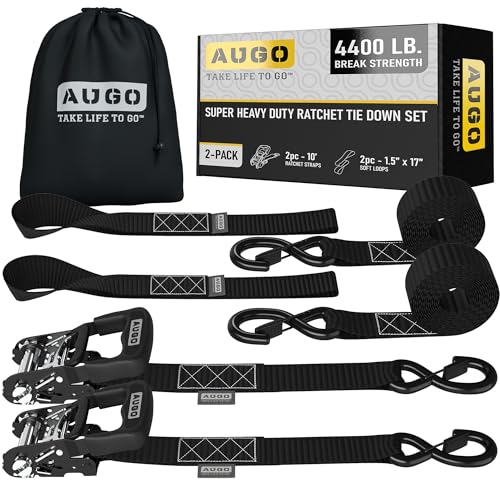
AUGO 1.5 in × 10 ft ratchet strap 2-pack
A two-strap AUGO kit with a published 4,400 lb break strength and 1,466 lb load capacity. Wider and shorter than the 15-foot editor's pick.
- Width
- 1.5 in
- Length
- 10 ft
- Quantity
- 2 straps
- Published working load
- 1,466 lb load capacity
- Published break strength
- 4,400 lb
- Fittings
- Rubber-coated S-hooks with safety latches
Break strength and load capacity are the manufacturer's published figures, not a StrapRank test.
Check price on AmazonThe AUGO review is the editorial page for the 15-foot kit. It is an opinion from published specs, not a claim that a new strap forgives a sharp edge. Pad the edge. The working load assumes webbing that is not being sawn.
Commercial cargo securement, 49 CFR Part 393, expects marked tie-downs used within their working load and inspected. A frayed strap on a commercial vehicle is an out-of-service problem, not a blog judgment call. Follow the regulation and the manufacturer. For a personal truck, the same inspection habit is how the load stays in the bed.
Catch the next fray earlier
Look at the edges when you put the straps away, not only when something looks dramatic.
- Run a hand down both edges. Stop for notches, not for ordinary softness
- Check stitching at both hooks and at the ratchet
- Keep webbing off sharp metal, or pad the corner with something that does not slide away
- Keep straps off exhaust and away from welders
- Store them dry and out of the sun. The storage guide is enough of a routine
- Replace at the first real cut, melted spot, opened hook, or missing tag
Two intact straps inside their marked working loads are the plan. One frayed strap you are watching is not a plan. Scrap it, route the next one away from the thing that cut it, and read the tag.
Questions readers actually ask
How much fraying is too much?
A notch, a cut yarn, melted or glazed fiber, popped stitching, or a missing tag is too much. Even surface fuzz with the edge cord still whole can stay, and you should watch that spot.
Can I wrap tape around a frayed spot?
Tape hides the damage and does not restore strength. If the spot is actually cut, retire the strap. If it is only surface fuzz, you do not need tape.
Does a higher break strength mean I can ignore small cuts?
No. Any cut puts you outside the assembly that was tested. Break strength is not a margin for damaged webbing. Replace it and use the working load on the new tag.
Keep reading
The strap these steps use
As an Amazon Associate I earn from qualifying purchases. Full disclosure. Specs on this page are the published listing figures, not a StrapRank lab test. The tag sewn on the strap wins, and a commercial load still has to follow the cargo-securement rules that apply to the trip. Recheck the AUGO listing before you buy.